

How thermals work, and how gliders use them
A thermal is a column of warm air rising from ground the sun has heated. A glider has no engine, so it climbs by circling inside that rising air, then glides to the next thermal and climbs again. Pilots find thermals under growing cumulus clouds and over sunny, dry ground, and they centre them by shifting the circle toward the side where the vario shows the strongest climb. On a good day in Central Europe a glider climbs at 1 to 3 m/s and can fly hundreds of kilometres this way.
What is a thermal?
The sun heats the ground, and the ground heats the air just above it. Some patches heat faster than others: a dry field, a south-facing slope, a village, bare rock. The air over them gets warmer and lighter than the air around it, breaks away and rises, the way a bubble rises in water.
As it rises it cools. If it holds enough moisture, it cools to its dew point and the water condenses: a cumulus cloud forms on top. The flat base of the cumulus is where that happens, and it is about the same height for all the clouds of the day.
Where do thermals form?
- Over ground that heats quickly: dry crops and stubble, sunny slopes, rock, towns, gravel pits.
- Rarely over ground that stays cool: forest, wet meadows, lakes, shaded slopes.
- Under cumulus that is still growing, with a sharp, firm base. A cloud that looks ragged and dissolving has usually finished.
- In wind, thermals lean downwind. The core at your height sits downwind of where it left the ground.
- Above about 20 km/h of wind, the clouds often line up in streets along the wind, with lift under the streets and sink between them.
How big are they, and how far apart?
A thermal core is a few hundred metres across. Around it the air sinks, so the space between thermals is often worse than calm air.
Measurements show thermals stand about 1.5 times the depth of the convective layer apart. With a layer 1,500 m deep, that is a thermal about every 2 to 2.5 km. Thermiker places its thermals this way, so they are closer together at noon, while the layer is shallow, and further apart in the afternoon.
The day has a rhythm. Thermals start weak in the late morning, the cloud base rises through the day, and both peak around 14:00 to 15:00 local time before they fade in the evening.
How do gliders find a thermal?
- Look ahead for a cumulus that is growing, with a dark, flat base.
- Look at the ground: a sunny slope, a dry field, a town upwind of you.
- Watch other gliders and birds. A glider circling and climbing marks a thermal. So do buzzards and kites circling without flapping.
- Feel and listen. One wing lifts, the seat pushes up, and the vario tone rises and beeps faster.
In Thermiker all of these cues are there: clouds that form, grow and decay over their thermals, ground that triggers or does not, other gliders circling in gaggles, birds in the thermals and a vario that sounds like an LX or a classic instrument.
How to centre a thermal
- When the vario rises, fly straight for two or three seconds, then turn toward the wing that lifted.
- Bank 30 to 45 degrees and hold a steady speed: about 1.15 times the stall speed for that bank.
- Watch where in the circle the climb is strongest. Ease the bank a little there, fly a few seconds straighter, then tighten again. The circle moves toward the core.
- Keep the yaw string in the middle. A slipping turn costs climb.
- Leave near the top, or when the average climb falls well below what you expect from the next one.
Circling speeds in Thermiker: 100 km/h in the 15 m glider, 90 in the ASK 21, 95 in the 18 m glider and 75 in the K 8 B.
Ridge lift
Wind that blows against a slope has to go up. On the windward side of a ridge the air rises, and a glider can fly along the ridge in that band of lift, close to the slope. On the lee side the air sinks and is often turbulent. Ridge lift needs a steady wind roughly across the ridge; in Thermiker a 30 km/h westerly onto the Hoher Meißner's west slope gives about 1.5 m/s at 100 m over the slope.
Wave
When a strong wind crosses a mountain range and the air above is stable, the air behind the range swings up and down in standing waves, like water behind a rock in a river. In the rising part a glider can climb smoothly far above the cloud base. Lenticular clouds, smooth and lens-shaped, mark the crests. Under the first crest, low down, the air tumbles in a rotor that is violently rough.
In Thermiker's Wave day over the Serra del Cadi the waves stand 6 to 10 km apart, lift reaches 4 to 5 m/s, and you can climb to 5,000 m and more.
See the air with the lift view
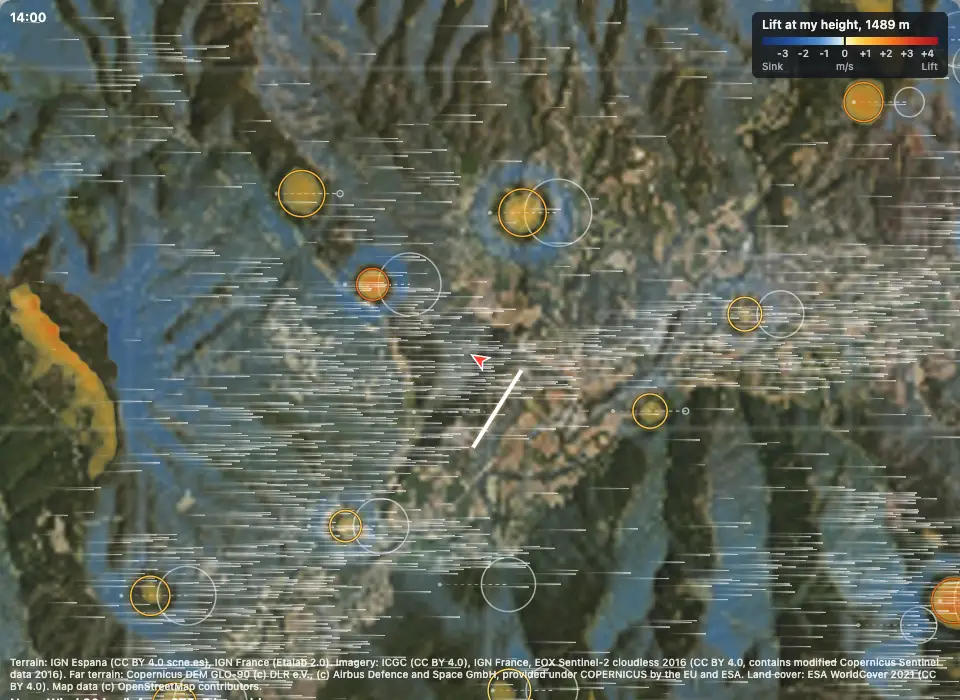
The lift view is a training aid in Thermiker that shows what you normally cannot see.
- On the map: lift in warm colours, sink in blue, with the wind as flowing lines. Zoom in and each thermal shows its core, the ring of sink around it, the bubbles passing through, and a dashed line for how it leans downwind.
- In 3D: dust rising in the nearby thermals, sinking air drifting around them, and streaks that run up the windward slope and down into the lee.
- As an arrow: it points to the strongest lift within 1 km, and a ring marks the core while you circle.
Use it to learn, then switch it off and find the next thermal by the clouds and the vario. Flights with the lift view stay in your logbook but do not count for best times, because no real pilot can see the air.
Fly with the lift view (turn it on under Settings, Lift view, or press L in flight)
Numbers from real flights
We measured 344 public IGC logs of real sailplane flights (most from SkyLines), with 6,917 thermal climbs in them. The medians:
| Median | |
|---|---|
| Climb in a thermal | 1.28 m/s |
| Time in one thermal | about 2.5 minutes |
| Bank while circling | 33 degrees |
| One full circle | 26 seconds |
| Circle radius | about 110 m |
| Glide between thermals | about 4.2 minutes |
| Speed on the glide | about 122 km/h |
| Share of the flight spent circling | 36 % |
Thermiker's realism bench uses these flights to check how its own soaring pilot circles, cruises and climbs. How realistic is it?
Keep learning
The DAeC (Deutscher Aero Club) publishes a free course, the basic training for glider pilots, in German: Segelfliegen Grundausbildung.
Related
- Learn to glide: lesson 5 finds a thermal, lesson 7 centres the core.
- Regions: where to try ridge lift and wave.
- Weather and lift in Thermiker: everything the weather model simulates, with numbers.