

Eight gliders, flown by the numbers
Thermiker, a glider simulator that runs in the browser, has eight sailplanes: a 15 m class racer, an 18 m glider with water ballast, the ASK 21 and Grob G 103 Twin II two-seaters, the K 8 B club single-seater, and three Standard Class classics, the Standard Cirrus, the Grob Astir CS 77 and the Glasflugel Standard Libelle. They all use the same flight model and differ only in their numbers: span, wing area, mass, wing sections, tail, inertia, speeds and limits, taken from published data. The figures below are measured by flying each glider in the sim, in calm air, not read from a table.
The hangar, one card per glider. Pick one and it opens in the game ready to fly.
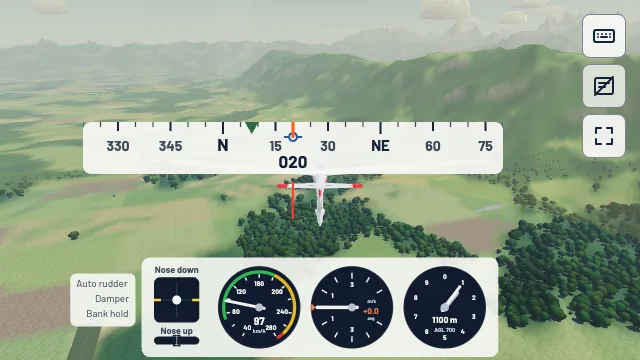 15 m classThe modern 15 m racer, quick and crisp. Where most pilots fly their first task.Fly this one
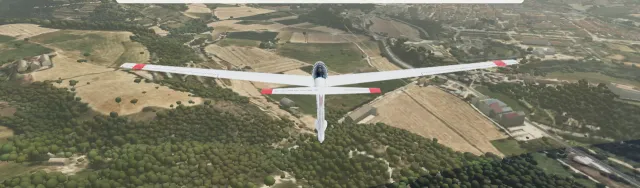 ASK 21The glass two-seater most clubs train in. Forgiving, and it will not spin at a normal centre of gravity.Fly this one
- 18 m classLong, slim wings and water ballast. The best glide of the fleet, modelled on the ASW 28-18.Fly this one
- K 8 BThe forgiving wooden club single-seater of 1957. Slow, gentle and happy in a tight thermal.Fly this one
- G 103 Twin IIGrob's glass two-seater with a T-tail. The trainer the winch-failure drill flies.Fly this one
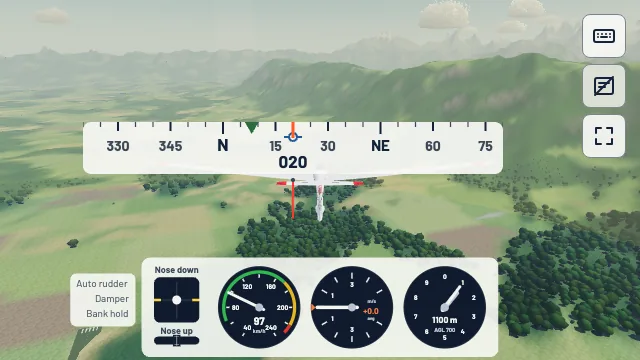 Standard CirrusThe classic 1970s Standard Class glass ship, with a light all-flying tail. Lively, and quick to drop a wing.Fly this one
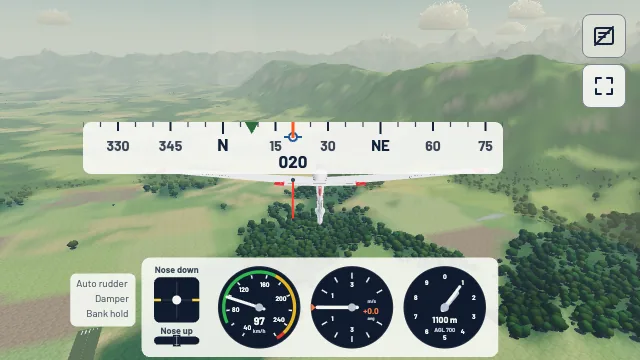 Astir CS 77Grob's sturdy Standard Class glass single-seater with a retractable wheel. A steady, popular club ship.Fly this one
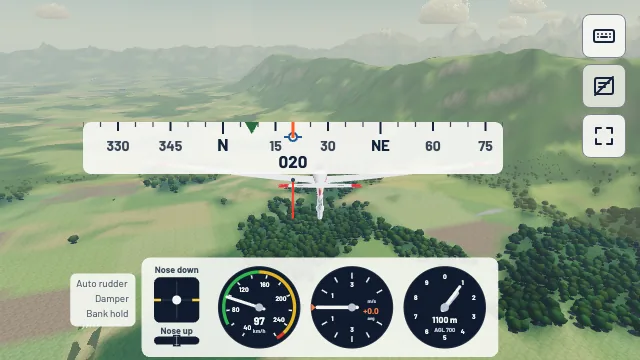 Standard LibelleGlasflugel's light 1960s Standard Class glass ship. Delicate on the controls and a fine climber.Fly this one
At a glance
| 15 m class | 18 m class | ASK 21 | G 103 Twin II | K 8 B | Standard Cirrus | Astir CS 77 | Standard Libelle | |
|---|---|---|---|---|---|---|---|---|
| Role | Single-seat racer | Single-seater with water ballast | Two-seat trainer | Two-seat trainer | Classic club single-seater | Standard Class glass, 1969 | Standard Class glass, 1977 | Standard Class glass, 1967 |
| Span | 15 m | 18 m | 17 m | 17.5 m | 15 m | 15 m | 15 m | 15 m |
| Wing area | 10.5 m^2 | 11.88 m^2 | 17.95 m^2 | 17.8 m^2 | 14.15 m^2 | 10.04 m^2 | 12.4 m^2 | 9.8 m^2 |
| Aspect ratio | 21.4 | 27.3 | 16.1 | 17.2 | 15.9 | 22.4 | 18.1 | 23 |
| Flying mass | 400 kg; 325 kg dry, up to 525 kg | 380 kg dry, up to 570 kg | 500 kg (two pilots) | 520 kg (two pilots) | 280 kg | 305 kg dry, up to 365 kg | 360 kg dry, up to 430 kg | 275 kg dry, up to 325 kg |
| Best glide (sim) | 42.2 at 108 km/h | 48.2 at 95 km/h | 34.2 at 90 km/h | 37.4 at 95 km/h | 27.5 at 73 km/h | 38 at 88 km/h | 37 at 94 km/h | 36 at 83 km/h |
| Min sink (sim) | 0.61 m/s at 83 km/h | 0.48 m/s at 75 km/h | 0.65 m/s at 73 km/h | 0.65 m/s at 78 km/h | 0.66 m/s at 60 km/h | 0.57 m/s at 73 km/h | 0.61 m/s at 73 km/h | 0.57 m/s at 71 km/h |
| Stall at 1 g (sim) | 72.5 km/h | 67.7 km/h | 64.8 km/h | 69.7 km/h | 53.3 km/h | 65 km/h | 64 km/h | 64 km/h |
| Roll 45 to 45 degrees at 100 km/h (sim) | 3.8 s | 4.8 s | 4.5 s | 4.8 s | 3.4 s | 3.6 s | 3.7 s | 3.6 s |
| Vne | 270 km/h | 270 km/h | 280 km/h | 250 km/h | 190 km/h | 220 km/h | 250 km/h | 250 km/h |
| Winch weak link | 660 daN | 825 daN | 1000 daN | 845 daN | 600 daN | 550 daN | 530 daN | 500 daN |
| Circling speed (lesson) | 100 km/h | 95 km/h | 90 km/h | 100 km/h | 75 km/h | 90 km/h | 90 km/h | 90 km/h |
Measured at the standard loading. Last checked in November 2026.
15 m class
The default glider and the one most pilots will fly first in a task. It stands for the modern 15 m and Standard Class single-seaters, and its numbers are checked against the published polars of the LS 8, Discus 2 and ASW 28. It is not a copy of one type, so it carries the class name.
Best glide is 42.2 at 108 km/h in the sim, against 41.6 at 99 km/h on the published LS 8 polar. It is a quick, crisp glider: 3.8 s to roll from 45 degrees one way to 45 the other at 100 km/h. Above about 160 km/h it sinks more than the published polar, up to 17 % more at 190 km/h. We say so on the realism page.
With the centre of gravity aft (a light pilot) it spins readily and recovers within a fraction of a turn with the standard recovery.
18 m class
A single-seater with 18 m of span, no flaps and wing water ballast, modelled on the ASW 28-18: the long-wing version of a Standard Class glider. Dry it flies at 380 kg; with water it goes up to 570 kg, and the best glide moves to higher speeds.
Best glide 48.2 at 95 km/h against 48 from the maker, min sink 0.48 m/s against 0.48 published. Of the eight, its polar sits closest to the published one: within 0.02 m/s at every speed we fly. With its long wings it rolls slower, 4.8 s for the 45 to 45 reversal.
ASK 21
The two-seat glass-fibre trainer that many clubs use for basic training. In Thermiker you fly from the front seat; the rear seat carries a second pilot or stays empty, and the weight and balance follow.
Best glide 34.2 at 90 km/h, against 34 from the maker. Stall 64.8 km/h at 500 kg, against about 67 km/h from the flight manual scaled to that mass. Like the real one, it will not spin at a normal centre of gravity: at full back stick it mushes with the wings level. With 2 kg of spin ballast on the fin (CG at 400 mm or aft), it spins and recovers within half a turn. The flight manual names the same 400 mm limit.
It has its own front panel with a mechanical vario, as in many club two-seaters.
Grob G 103 Twin II
Grob's two-seat glass-fibre trainer from 1980, built 549 times and still flown in many clubs. It has a T-tail, a fixed main wheel just behind the centre of gravity with a nose wheel ahead of it, Schempp-Hirth airbrakes on the top of the wing and an Eppler 603 wing section about 20 % thick. Loaded, it rests on the main wheel and the nose wheel, nose down.
Best glide 37.4 at 95 km/h in the sim, against 37 at 580 kg from the flight manual and about 33 measured by R. H. Johnson in his flight test (Soaring, February 1983). Stall 69.7 km/h at 520 kg; the manual gives 66 km/h at 470 kg and 75 km/h at 580 kg. Two-up it does not spin. Solo with a 70 kg pilot (CG at 446 mm) it spins at about 69 degrees per second and 87 km/h. The manual says a turn every 3 s, so the sim spins slower. It rolls from 45 to 45 degrees in 4.8 s at 100 km/h.
The winch failure challenge flies it, as clubs train launch failures in a two-seater.
K 8 B
The Schleicher K 8 B from 1957: steel tube and fabric fuselage, wooden wing, a big rounded rudder and a nose skid. Generations of pilots flew it as their first single-seater after going solo.
Slow and gentle: it stalls at 53.3 km/h (references give 52 to 55), glides 27.5 to 1 at 73 km/h (the maker gives 25, the published polar 27.2) and thermals in tight circles at about 75 km/h. With a 70 kg pilot it spins steeply and recovers at once with the usual recovery; with a 90 kg pilot it does not spin.
Its cockpit has the period panel: airspeed, a mechanical vario, an altimeter, a small electric vario and a radio. No glide computer. More on the wooden classics in vintage gliding.
Standard Cirrus
Klaus Holighaus's Standard Class glass single-seater of 1969: a slim pod-and-boom fuselage, a flapless shoulder wing, a retractable wheel, wing water ballast and a light all-flying tail. One of the shapes that defined the class.
Best glide 38 at 88 km/h in the sim, against the maker's 38.5; min sink 0.57 m/s at 73 km/h. It is lively in roll, 3.6 s for the 45 to 45 reversal, and known for a sharper stall than a trainer: with the centre of gravity aft it drops a wing and spins, recovering within a turn with the standard recovery.
Grob Astir CS 77
Grob's Standard Class glass single-seater of 1977, the glider many pilots flew as their first glass ship after the K 8. A mid wing, a retractable wheel with a tailwheel, Schempp-Hirth airbrakes on the upper surface and wing water ballast.
Best glide 37 at 94 km/h, against the maker's 38; min sink 0.61 m/s at 73 km/h; stall 64 km/h at 360 kg. Steady and honest: it spins only with the centre of gravity well aft, slowly and flat, and the standard recovery stops it within a turn.
Glasflugel Standard Libelle
Eugen Haenle's light Standard Class glass single-seater of 1967, built by Glasflugel. Thermiker models the Standard Libelle 201 B, with wing water ballast and a conventional tail. At 275 kg dry it is the lightest single-seater in the hangar.
Best glide 36 at 83 km/h, min sink 0.57 m/s at 71 km/h, stall 64 km/h at 275 kg. Light and feelsome on the controls, 3.6 s for the 45 to 45 reversal, and a fine climber in a narrow thermal.
How the numbers are made
- Polar: a steady straight glide every 2.5 km/h from just above the stall to near Vne, 12 s per point after 8 s to settle.
- Stall: the speed bleeds off at about 1 km/h per second, wings level. The stall speed is the lowest speed at 1 g.
- Roll: a reversal from 45 degrees one way to 45 the other at 100 km/h, full aileron, coordinated rudder.
- Spin: full back stick and full rudder from the stall warning for 12 s, then the standard recovery.
Our test suite flies all of this again on every run and fails when a result no longer matches the published numbers. In the game, the Learn tab has the same comparison as charts: "How realistic is it?"
What is not there yet
Eight types, against many more in the big desktop simulators. No flapped glider yet, and no motor glider. Every glider wears one white and red scheme with your own competition number; there are no maker logos or real liveries.
Related
- How realistic is it?: the full comparison with sources.
- Learn to glide: which glider to start in.
- Vintage gliding: old films and why the classic wooden gliders matter.
- Thermiker vs Condor 3: how the line-up compares.